| New Search :
Result for Part Number: Brennan, John Pop : Item Detail |
| John `Pop` Brennan |
|---|
|
| Paraphrased from the web site http://californiabicyclemuseum.org/gallery/era/4/134
John “Pop” Brennan began his metal working career as a chandelier maker. He learned the fine art of tube bending and joinery while fabricating exquisite chandeliers for grand theaters in New York and other major cities. Later in his Newark, NJ workshop he used this skill to bend steel for handlebars and frames. As a master frame builder, Brennan built some of the most beautiful frames of the time and many consider his work to have led the way for handbuilt American frame making. He understood the mechanics of the machine and the needs of the rider. Each frame was built specifically for road, track sprint events, or six-day racing. Brennan frequently built multiple forks for riders to change the handling of the bike by simply changing the fork.
Brennan built a bike for New Jersey racer Charley Logan in the 1930’s. Charley Logan was a six-day racer from the late 30’s to the late 40’s. Logan’s bike was built in the style of Willy Honeman’s machine with the design effort focused on delivering a lightweight machine that could withstand the extreme use of a professional six-day racer. Willy Honeman was the 1924 junior National Champion and the Pro Sprint Champion in 1934, 1935, and 1936. Inducted to the U.S. Bicycling Hall of Fame in 1996, Honeman was the first American to wear an actual stars and stripes jersey. His only surviving jersey (denoted as jersey “1”), is part of the U.S. Bicycling Hall of Fame collection.
Brennan used the Honeman machine as a platform for marketing his bikes and created a brand identity of bikes built in the Honeman style (see the Honeman magazine advertisement). Having been raced hard by Logan in many years of professional racing, this bike was severely damaged when it was acquired by Jeff Groman in 1997. The down tube and top tube were broken so a complete restoration was in order. The paint was originally applied by Howard Rupprecht of the Irvington Paint and Varnish Co. in Irvington, NJ and the restoration paint is a very close duplicate of the original paint color, design, and execution (see the restored bike illustrated here, now owned and displayed by Jeff Groman.
The exquisite lug work shows that Pop started with heavy cast lugs and then thinned and hand sanded them to a light and functional weight. He handcut the head lugs to reveal bands (painted black) in a style that was often copied by other custom frame builders who followed the Brennan legacy. His “sweet bend” fork was a work of art with a masterful effort to flair the fork ends out and forward. This result is shown on the photo of Jimmy Walthour’s machine as viewed head-on. All the Brennan fork tips were cut from Brown and Sharp steel that were thicker and stronger than stock fittings (see template photo) to provide durability and increased stiffness and secure wheel mounting for high-speed sprinting.
When assembled with state of the art components and wooden rims, Brennan track cycles could weigh as low as 16 pounds. In this way of creating functional art that passed the performance demands of top professional racers, John Brennan along with frame building greats Oscar Wastyn, Willy Appelhans, Lance Claudel, Alvin Drysdale paved the way for generations of American frame builders.
The past few years have brought a return to the art and craft of the steel bicycle. Fortunately, a dedicated group of American frame builders has kept the fires burning and the art of steel bicycle frame building has seen a recent resurgence. With this resurgence, builders can once again look at the old frame details from master builders such as Pop Brennan for inspiration and guidance. The restored Charley Logan machine is now fully functional with period-correct components and an original set of very rare wooden rims brought from Europe by Willy Honeman. Although Brennan built frames from the 1920’s to the late 1950’s, he did not use serial numbers so the exact number of frames that he built is unknown.
Jeff Groman: Jeff Groman is the owner of Classic Cycle, Bainbridge, WA and producer of the book and DVD titled: Six-Day Bicycle Race: America’s Jazz-Age Sport. A New Jersey native, Jeff has extensively researched the history of six-day racing in the United States. Jeff was asked to provide a bike of the month for the May 2009 California Bicycle Museum email newsletter. He provided the background details and photos for the Charley Logan machine and selected the machine to help recognize the role of the New Jersey frame builders in influencing the legacy of American handbuilt frame manufacturing.| Picture Gallery for this Item (click images to enlarge) |
|---|
more details
From the United States Bicycle Hall of Fame at http://www.usbhof.com/inductees/1996.cfm
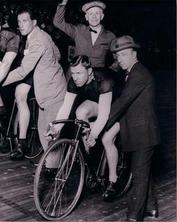
John "Pop" Brennan grew up in Newark, NJ at the height of cycling popularity in the United States. He started racing in 1904 winning the Diocesan Union Championship. He turned Pro after winning an amateur 6-day race in Atlantic City, NJ. He retired after a short pro career and opened a bike shop where he made custom handlebars and wheels for some of the cycling greats like Frank Kramer and Alf Goullet. He set up his portable bike shop at many of the tracks that hosted six day races, including Madison Square Garden, the Chicago Coliseum and others in North America and Europe. His shop became a repository for scrapbooks, photos and oral and written history of the golden age of American cycling. His history is now a part of the United States Bicycling Hall of Fame. This picture is of Pop Brennan holding ace racer Alf Goulett at the starting line of a track race.
|
|
|
| ProteanPAPER Business Software
|


