| New Search :
Result for Part Number: Ingo Bike 1930`s.a : Item Detail |
| INGO BIKE Produced by Ingersol 1934~1937 (A scooter type bicycle) |
|---|
|
Item# Ingo Bike 1930`s.a [Ingo Bike 1930`s.a]
Categories: Photo Gallery-Index of bikes & stuff for Your Research, Who's Who-Mfgr's of Bicycles, Tricycles and/or Wheel Goods & Employees, | |

 | | Since Howie Cohen's passing, no items are for sale. | | The Ingo-Bike is a scooter type two wheeled vehicle that was produced between 1934 and 1937 by Ingersol (a subsidiary of Borg-Warner Co of Chicago, IL). The inventor and patent holder was Phillip Huyssen. I gleaned the full story about the Ingo-Bike from Dave Stromberger`s web site click here. See the picture gallery #08 for the full story, history and more pictures of this unusual product; the story was authored by Mary Miller. I had and rode an Ingo-Bike as a 7 year-old child when my family lived in Mpls, MN. My parents owned a bike shop and sold the Ingo-Bike as one of the product lines in the store. Well known collector Scott McCaskey has an Ingo-Bike available for sale as of February-2012, if you are interested email Scott directly click here. |
| | Picture Gallery for this Item (click images to enlarge) |
|---|
more details
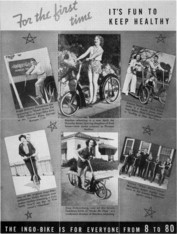
A marketing brochure showing some Hollywood celebrities riding the Ingo-Bike. Included are: Helen Morgan, Dorothy Stone, Ralph Bellamy and others. |
more details
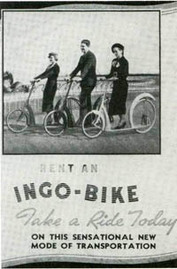
An advertisement for teh Ingo-Bike in the 1930's. |
more details
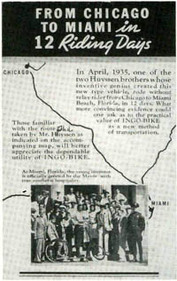
The 1935 marketing material using his Ingo-Bike on a ride from Chicago to Miami, FL that Phillip Huyssen accomplished in just 12 days. |
more details
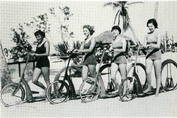
Originally published in the 1979 Wheelman Magazine, Gleaned from http://www.nostalgic.net/bicycle563
Authored by Mary Miller
The Ingo-bike was invented by two brothers, Phillip and Prescott Huyssen, during the early 1930′s. Its safety and versatility - two could ride as easily as one – made it a healthy source of family fun. The Ingo’s revolutionary driving principle was akin to perpetual motion, and its ride was compared to “the sensation you get standing at a ship’s bow enjoying the lift and lull of the rhythmic swell as the ship rides high on the crest and gently falls into the trough of the wave.” It was touted at the time as the “first great advance in wheels in almost half a century.”
Phillip Huyssen got the idea for the Ingo while he and Prescott were returning home from the Chicago World’s Fair. They were riding in the upper deck of a double-decker bus in order to enjoy the view. While riding south on South Park Avenue, Phil began to watch a group of small boys riding home-made scooters. The scooters were made of 2×4′s and used a roller skate for wheels. One board was used to stand on, one to steer, and a cross-stick was used for handle-bars. One boy was using a 1×6 instead of a 2×4 to stand on, and when he pushed off, the board would hit the sidewalk and act as a brake. As Phil watched the boys, he got an idea, and told Prescott that if the rear wheel hub was off-center, the scooter could be propelled by pulling on the steering bar, and using a little “body English.”
The two brothers went home, and began to work on their idea. They built a number of scooters with various size wheels and experimented with putting the eccentric wheel in the front and then in the back. These being depression days, there was no work and the banks were closed, the brothers were short of money and often had to improvise. The first working Ingo had a 12-inch front wheel and a 36-inch rear wheel. They tried it out on a cold winter night, but avoided riding in their neighborhood at 70th and Calumet in Chicago, as they feared the neighbors would think they were crazy. This first success greatly encouraged the Huyssens, as they had invested hard-to-get money into their invention. They continued their work and made a final prototype with an 18-inch rear wheel made of 3/4-inch plywood wrapped in hard rubber. The bike received U.S. patent no. 1,679,819 with others pending.
The Huyssens took their prototype to Derinforth, Lee, Criten, and Wiles-Patent Attorneys. They demonstrated their invention to their attorney, Horace Dawson, by riding it in the hallways of the office building, and he liked it very much. The brothers borrowed some money and had movies made to show the Ingo in action. They took it to the Toy Fair in New York City where the bike was a hit. The Huyssens received hundreds of tentative orders while they were at the New York’s McCalpine Hotel. On their return from New York, Mr. Dawson recommended giving the idea to Borg-Warner Company, a manufacturer of automobile, home appliance, aviation, marine, and agricultural products. They decided to release the Ingo-bike idea to Borg-Warner Company, who then transferred it to a subsidiary, Ingersol. The two brothers then spent some time testing the design at the Borg-Warner plant in Rockford, Illinois.
Production of the Ingo was set up in the fall of 1934. Many mistakes were made in the first construction, and a second, improved version was later developed. The second version was quicker and easier to ride, but it still had one drawback, its curved, steel platform supports would crack between the wooden riding platform and the rear wheel when the bike was ridden too hard. Then the rider would have to take the two halves of his broken Ingo to the nearest welding shop. The bike was also very heavy which provided the rider with good exercise or a lot of work, according to his point of view.
Unfortunately, the Ingo was only manufactured for a short time. Production stopped in 1937, when the building the Ingo was made in was converted into an army shell factory. Then World War II broke out, and the Ingo idea was side-tracked.
The Ingo is both a novel and practical invention. It steals the show at any parade, and can be used in eye-catching tricks, such as jumping over low-fences, and pyramid riding in which a group of people form a pyramid while riding on an Ingo. In Hollywood it was pictured in many magazines, ridden in movies and in a Three Stooges comedy and it was featured in the Pathe News. In the 1930′s, rental agencies from Hollywood beaches, to New York’s Central Park, did a substantial business renting out Ingos and teaching people how to ride them. They often gave out membership cards, which allowed the carrier to ride for free, after having paid for a certain number of rides. Games such as Ingo-polo became popular. Regular Ingo races were held at Victor McLaglen’s Hollywood Sports Center in the ’30′s, and today these bikes which can reach speeds of up to 20 miles per hour are raced on the quarter-mile track at Wheelmen meets.
The Ingo is not only fun to ride, it is also one of the safest bikes ever invented. The riding platform is only six inches from the ground, so injuries from falling or being bounced off are unlikely. There are no chains, sprockets, or gears to catch fingers or clothes, and the fenders prevent both flying mud and injuries from the wheels. When compared to modern-day 10-speeds, the Ingo bike doesn’t seem to be a distance machine, but its inventors proved otherwise. On one of their early rides, Prescott and Phil rode from Chicago to Milwaukee, Wisconsin, in 8-1/2 hours. On another long and widely publicized ride, Phillip Huyssen rode from Chicago to Miami, Florida, in April, 1935. The trip took him 12 days, and on his arrival he was officially greeted by the mayor of Miami. Six Ingos were shipped to Florida for publicity on his arrival, and many people learned to ride there. This ride also led to the Ingo being featured in the Miami Chamber of Commerce promotional magazine.
The inventors weren’t the only people who used the Ingo for long-distance travel. A 113-mile long Ingo-bike derby, running from Los Angeles to the Desert Circus Day Celebration in Palm Springs, California, was planned both to prove the practicality of the Ingo for traveling long distances, and to demonstrate the ease with which it could be used for sport and to improve one’s health.
Many people used the Ingo for basic transportation, and office workers bouncing to work down Woodward Avenue were a familiar sight in World War II era Detroit. Others rode the Ingo as a safe, effective way to keep in shape. Ingo riding was promoted as a health-giving sport and was compared to tennis and jogging. It was advertised as a new Hollywood craze, used by the stars to keep their healthy good looks. The exercising theme was carried out in the Ingo’s original name, “Exercycle,” which was used in early news accounts. Its name was later changed to Ingo because R. C. Ingersol made “Ingo-clad” steel. Ingo-riding was touted as a gentle, rhythmic, non-monotonous daily exercise, which was a pleasant way to lose weight and gain perfect posture, poise, and balance. Ingo-riding was said to flex the muscles, rest the nerves, tone the system, and renew vitality. The slogans, “It’s fun to keep healthy,” and “The Ingo is for everyone from 8 to 80,” promoted this idea.
In recent years, the Ingo has not been forgotten. Wheelmen from all over the country collect, restore, and ride them. In various cities, modern bicycles which have been customized with an Ingo-like off-center rear hub, have been ridden in parades and as street bikes. Phil Huyssen has continued working on the Ingo idea. He has made a child’s scooter patterned after the Ingo and is trying to make connections with a company to develop it. Mr. Huyssen also obtained a patent on an improved, easier-riding Ingo in 1972, which he hopes to get into production. |
|
|
| ProteanPAPER Business Software
|

